
Speak the Name: Part Two
II. In Whose Name? (Matt. 28:19–20a)
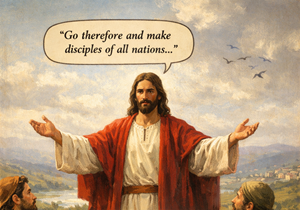
“Go therefore and make disciples of all nations, baptizing them in the name of the Father and of the Son and of the Holy Spirit, and” (vv. 19–20a NIV)
The Great Commission itself is a single sentence in both the Koinonia Greek and English translations and is built around a single imperative. Now I am not a Greek or English expert. To tell the truth,, I had to turn to AI for some help. This is what I learned: “An imperative in Koine Greek is a verb form that expresses a command, instruction, or urgent request. It functions much like the English “Do this!” or “Stop that?” but with some uniquely Greek features.
The imperative in our scripture passage, in Greek, is “make disciples.” Everything else in the sentence is subordinate to that. It is not in the Going. It is not in the Baptizing. It is not in Teaching. The mission is about disciple-making. Again, our mission is not to go baptize or even to teach; it is to make disciples.
Jesus says, before his command to make disciples, "Go therefore." As we “go therefore” in our lives, we are to be about reproducing in others the kind of life that has been formed in us. This is to be missional. All of us are called to make disciples. This imperative is not only for missionaries, ministers, evangelists, and Bible teachers. As we go forth in our daily walk, we are to be about making disciples.
Now that brings up the question - Where are we supposed to go? First, I want you to consider the reach of this mission. It is breathtaking. As the body of Christ, we are to go to All Nations. This mission was not for Jewish people only. This was not an Old Testament mission focusing on Jerusalem and the Middle East where the disciples were comfortable or already known. Barry Davis says, it’s “All nations — every ethnicity, every language, every culture, every geographic and political boundary that human beings have ever drawn. The risen Christ stands over all of them equally, because all authority in heaven and on earth has been given to Him, which means no nation is outside His jurisdiction and no person is beyond His reach.”
So far, we understand that Jesus told us to go make disciples, and now he says to baptize these new disciples. So now we are to go make disciples and baptize them. However, baptism does not make a person a disciple. A person can be a disciple before they are baptized, and most likely will be; in fact, the early church required rigorous catechetical studies before baptism. Baptism is a public confession of entrance into that life of discipleship. Of course, this means someone, perhaps you, has previously presented the good news of Jesus’ resurrection to someone, they have repented, and confessed their faith in Christ, and then are baptized “in the name of the Father and of the Son and of the Holy Spirit.” (Matthew 28:19)
This is the only place in Scripture where the full trinitarian name is spoken as the name into which a person is baptized. I want you to know that they are not signing up for membership in a religious organization, as one might with an organization like Rotary. They are not completing a rite of passage like you might do the Order of the Arrow in Boy Scouts. They are being immersed, sprinkled, or poured into the name — the identity, the character, the relational life — of the triune God. Baptism is the public entrance into the life of the Trinity itself. The new believer makes their confession of faith in the triune God public and enters into a relationship that mirrors the relationship that has existed among Father, Son, and Spirit since before the world began. Remember, Genesis tells us that we were created in the image of God and now baptism represents the restoration of that image.
The Trinity is not a theological puzzle like a Rubik’s cube to be solved and then set aside. “It is the name into which every believer has been welcomed. It is the community into which the commission sends us — and into which every person we bring to faith is invited to enter.” (Barry Davis)
So now we are to go forth to make disciples, to baptize them and to teach them to obey everything that I (Jesus) have commanded you. The ongoing path of discipleship after baptism is teaching. I am not talking about the mere transfer of theological correctness or the hearing of a sermon each week, but the continued formation of spirit. The goal of spiritual formation is that we are to become more like Jesus — humble, loving, sacrificial, truth-telling, mercy-extending, God-glorifying. The church is not a country club for Christians; it is a hospital for sinners. It does not exist for itself. It exists to birth and nurture disciples, in the name of the God who made them and the Savior who redeemed them.
“We are on a mission from God,” to borrow a quote from the Blues Brothers. Church, God has neither revised nor rescinded it. Churches and denominations may cease to be missional in their outreach, but God has not. God wants not one to perish. We are Plan A for reaching the world for God the Father, God the Son, and God the Spirit, and He has no Plan B!