
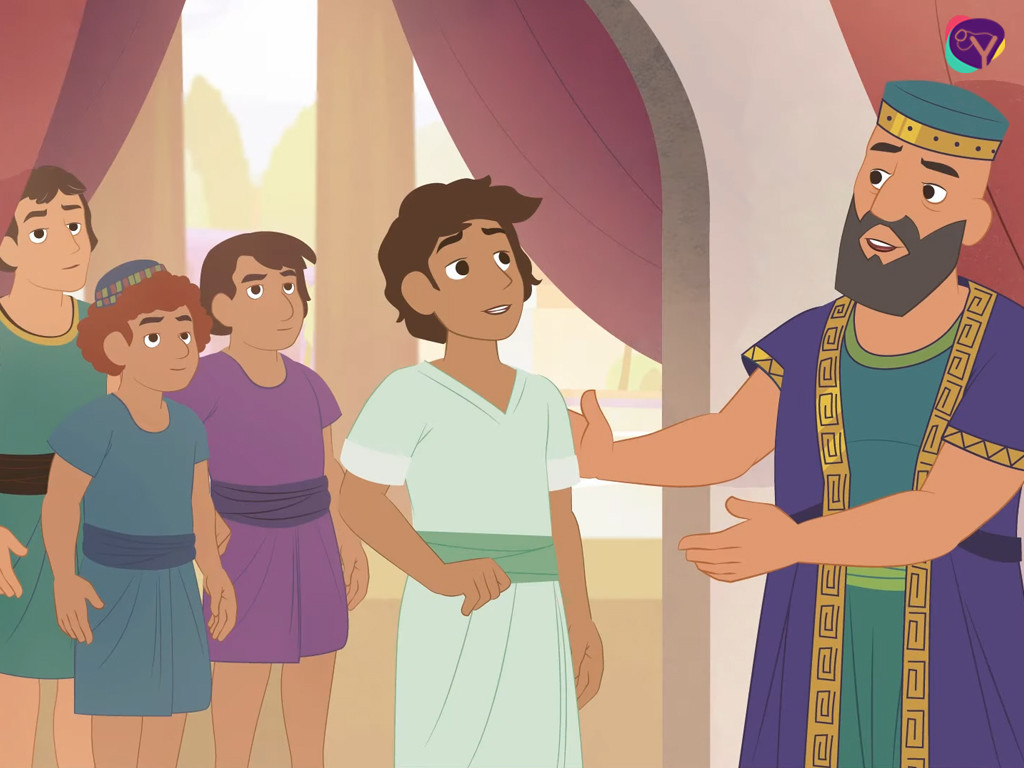
Standing Firm In a Foreign Land (Daniel 1:1-21)
There are moments when life suddenly shifts—when the world we knew is gone, and we’re left standing in unfamiliar territory. A diagnosis. A job loss. A cultural change. A fractured family. A season of grief. A church transition.
Now imagine being fourteen. Instead of graduating high school and going to college, soldiers storm your home, drag you away, and march you eight hundred miles to a foreign land. Your parents are gone. Your friends scattered. Your plans were shattered. Your faith pushed to the breaking point. For many in our world, this isn’t ancient history —It’s happening right now.
The question becomes: How do we stay faithful when everything around us feels foreign?
Daniel 1 speaks directly into that tension. It’s not really about lions or fiery furnaces as portrayed in children's Bible storybooks. It’s about four teenagers — likely 13 or 14 — figuring out how to stay faithful to their culture while forced to live in a culture that is determined to reshape them. Our young men and women face the same pressure today when they attend college. The pull to reject their faith is strong and compelling. Research says that 23% of teens ages 13-17, even before they get to college, will see themselves as “nones” or having no religious affiliation. Over 50% of the students who identified themselves as being Christian when they were first-year students at college will, by the time they graduate, have abandoned their Christian faith.
In 605 BC, Babylon conquered Jerusalem, and Nebuchadnezzar began a strategy of cultural takeover not unlike our colleges and universities today. He took the brightest young people, immersed them in Babylonian life for three years, and trained them to serve his empire. It was a forced cultural conversion.
But here’s what Nebuchadnezzar didn’t expect:
some people have a faith that cannot be shaken, no matter how far from home they find themselves. What makes the difference?
Church, we may not be living in ancient Babylon, but we are living in a foreign land, perhaps a new Babylon.
We're surrounded by a culture that increasingly views biblical Christianity as outdated, irrelevant, and even dangerous. The pressure to conform, to blend in, to compromise our convictions has never been greater. Let me be clear.
The question isn't whether you'll face pressure to compromise; it's how will you respond when that pressure comes. Let me repeat that. The question isn't whether you'll face pressure to compromise; it's how you'll will react when that pressure comes. Will you be unbending like an oak tree, or will you be like a bending and twisting willow in a windstorm?
Daniel's story teaches us that unshakable faith doesn't happen by accident. It's built through four essential characteristics that I want us to examine together this morning.
First, we must have a:
1. DEEP INNER RESOLVE
Daniel 1:8 says “But Daniel resolved not to defile himself with the royal food and wine…”
I want you to notice one small, powerful word: but.
· Everything was against Daniel’s faith — but he stood firm.
· He lived in a pagan culture — but he stayed faithful.
· He was cut off from godly influences — but he held his ground.
· He was trained in Babylonian ways — but he didn’t compromise.
Scripture tell us that Daniel was resolved.
What does it mean to be resolved?
Continuing In Daniel 1:8, the phrase “Daniel resolved” means more than a quick decision. It’s a pre‑decided loyalty, a settled posture of the heart before the pressure comes.
This isn’t a New Year’s resolution. It’s a firm, unwavering commitment to do what is right — no matter the pressure, difficulty, or cost.
The Hebrew word sim means “to set” or “determine.” Daniel had already decided who he would be long before the test arrived. Like the old hymn “I have decided to follow Jesus.”
We need people with deep commitment.
. But every one of them stopped at the line they had drawn hours earlier. Not because they felt brave, but because they had already decided.
And that pre‑decision saved their lives.
Life’s storms may be fierce, but when your foundation is secure, you don’t move. You know who you belong to and what you’re called to do.
Daniel’s test wasn’t about diet trends. He rejects the king’s food because the meat would have been offered up to idols. Refusing it was dangerous — it could cost him his future or even his life.
Yet Daniel chose spiritual purity over physical comfort, long‑term faithfulness over short‑term gain.
How This Applies Today
· At work — have you already decided to be honest, even when dishonesty could protect you?
· In relationships — have you chosen moral purity before temptation shows up?
· On social media — have you resolved to speak truth with grace, even when sarcasm gets more applause?
Unshakable faith starts with predetermined deep resolve. If you wait until the moment of temptation, it’s already too late. You must draw your line in the snow and vow to go no further. Daniel stood firm because he decided early.
Church, the time to decide who you are is not when the pressure hits. Not when temptation stands in front of you. Not when culture pushes.
To be deeply resolved is drawing your line in the snow — before the storm comes.”
2. A DISCIPLINED LIFESTYLE
Daniel didn’t just say no—he offered a better way. That’s the heart of a disciplined life.
Look at Daniel 1:12–16. Daniel proposes a ten‑day test: vegetables and water instead of the king’s rich food. At the end of the ten days, he and his friends look healthier than everyone else. God honors their faithfulness.
What’s happening here isn’t really about diet. It’s about discipline—consistent choices in the same direction. Daniel models respectful resistance, not rebellion. He doesn’t protest; he proposes. He doesn’t demand; he demonstrates. Discipline isn’t dramatic. It’s daily.
Daniel was willing to order his life around what mattered most. “Give us ten days,” he said. He trusted God enough to stake his future on obedience. His diet was an act of devotion, avoiding food likely tied to Babylonian idol worship. His habits aligned with his holiness.
And the question comes to us: are we willing to live this way? When coworkers pressure you to cut corners, do you offer a better path? When friends invite compromise, do you suggest something wiser? Are you willing to say “no” to good things so you can say “yes” to the best things?
Discipline means choosing what forms you, not what flatters you.
Daniel couldn’t guarantee the outcome—but he trusted God with the results. And God made the results unmistakable. Their disciplined lifestyle became visible evidence of God’s blessing.
Spiritual disciplines work the same way in us. When we voluntarily limit ourselves—through prayer, fasting, Scripture, service—God shapes our character and strengthens our faith. Not always in the ways we expect, but always in ways that matter.
Maybe for you it’s turning off Netflix for family devotions. Maybe it’s fasting from social media to pray. Maybe it’s serving at WARM instead of sleeping in. Discipline isn’t about earning God’s favor—it’s about making room for His work in us.
A world‑class violinist was once asked in an interview,
“What’s the secret to your extraordinary skill?”
People expected her to talk about talent, passion, or inspiration.
Instead, she smiled and said:
“Every day — even on concert days — I spend an hour on scales.
Scales aren’t exciting.
No one applauds scales.
But scales shape everything else.”
She explained that when she was young, she hated practicing scales. They felt boring and repetitive.
But her teacher told her:
“If you skip the small disciplines, you will never be ready for the big performances.”
Years later, when she walked onto the stage of Carnegie Hall, she didn’t rely on adrenaline or talent.
She relied on thousands of unseen hours of disciplined practice.
Her greatness wasn’t formed in the spotlight — it was formed in the quiet, daily habits no one ever saw.
Daniel’s ten‑day test was simply
daily obedience:
• Quiet faithfulness
• Repeated discipline
• Small choices that shaped his soul
• Integrity when no one was watching
And God honored it.
Daniel didn’t suddenly become courageous in the lions’ den. That courage was formed years earlier—one disciplined choice at a time, starting with vegetables and water.
Church, we often want the courage of Daniel in chapter 6, but we forget the discipline of Daniel in chapter 1. Great faith is formed through small, daily choices. Discipline isn’t glamorous—but it is transformative.